
Most L&D Intitiatives Don't Stick: Custom designed AI Agents could help change that.
The $100 Billion Problem Nobody Wants to Talk About
Every L&D leader knows the feeling. You've just wrapped a leadership development program — two days of workshops, world-class facilitators, engaged participants. The feedback forms glow. Three months later, nothing has changed.
This isn't a failure of intent. It's a failure of design. The global leadership development market is worth approximately $100 billion a year and growing, yet most organisations still rely on event-based training — workshops, offsites, courses — that deliver a burst of insight with no mechanism for sustained follow-through. Participants return to their desks, inbox avalanches resume, and the carefully designed learning fades into memory.
If you're an L&D manager, HR director, or People & Culture leader at a mid-to-large enterprise, you've likely spent years trying to solve this. You've tried post-workshop surveys, action plans, buddy systems, manager check-ins. Some help. None scale. And none give you the data you need to prove to the executive team that the investment actually changed behaviour.
That's about to change — and the shift is already underway.
The Rise of AI Agents in Enterprise Learning
The conversation around AI in L&D has evolved rapidly. In 2024, it was about content generation — using AI to produce e-learning modules faster. In 2025, the focus shifted to AI coaching platforms. Now, in 2026, the frontier is something more powerful: custom AI agents designed for your specific development programs.
Gartner predicts that 40% of enterprise applications will integrate task-specific AI agents by the end of 2026 — up from less than 5% in 2025. Josh Bersin's research confirms that the enterprise learning tech market is transforming around AI at an unprecedented pace, with agentic AI reshaping how organisations think about workforce development.
But here's what matters for L&D leaders: the opportunity isn't in generic AI tools. It's in agents designed around your capability frameworks, your program content, and your people's development goals.
What Custom AI L&D Agents Actually Look Like
Forget the chatbot on your intranet. Custom AI agents for learning and development operate in three distinct modes, each addressing a different gap in the traditional learning cycle.
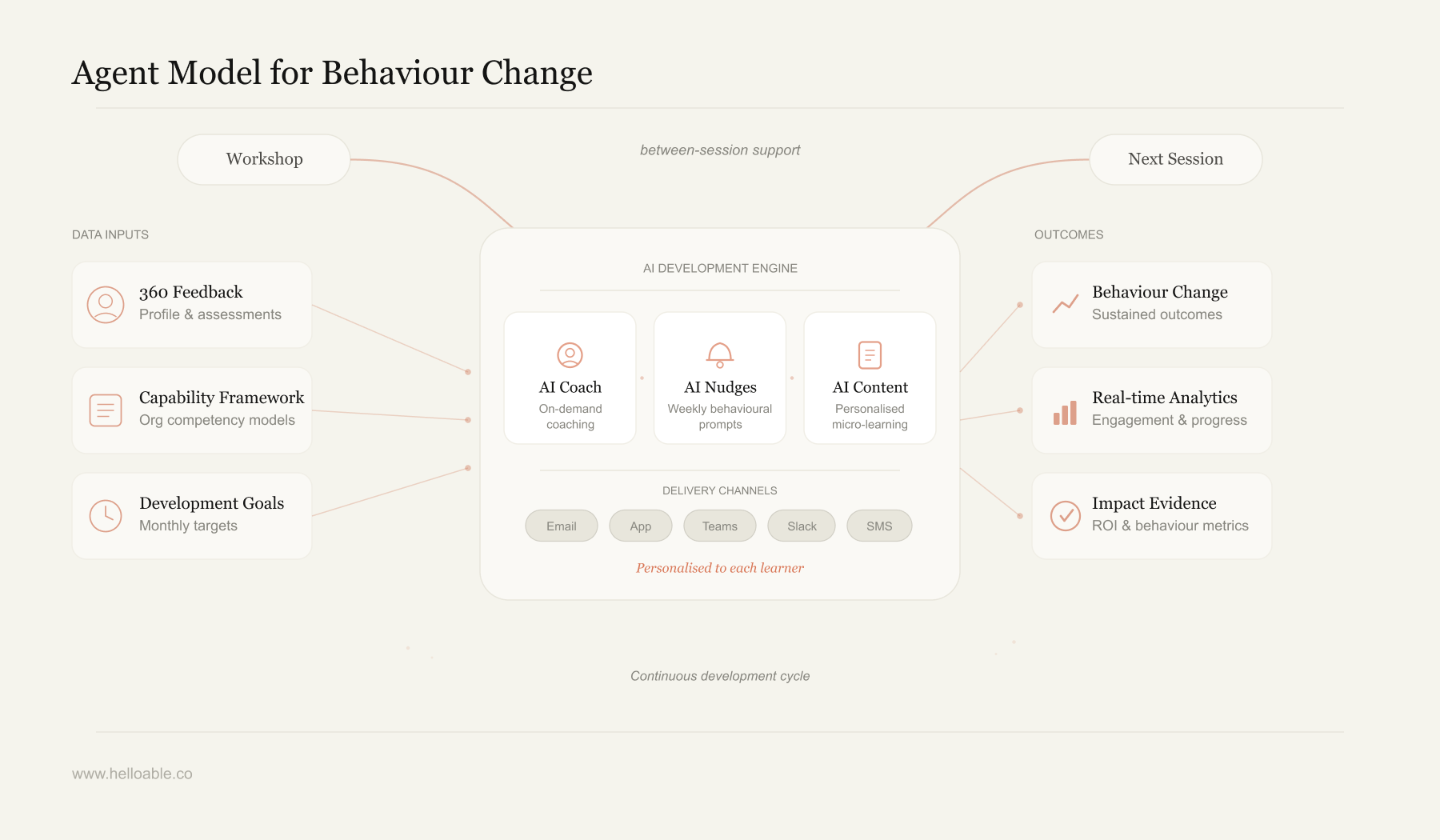
AI Coaches provide unlimited, on-demand coaching conversations aligned to each participant's development plan, 360-degree profile data, and program goals. Unlike generic coaching bots, these agents are trained on your organisation's capability framework and leadership model. A participant working on stakeholder influence doesn't get generic advice — they get coaching grounded in the specific competencies your organisation has defined, informed by their own feedback data.
AI Nudge Systems deliver short, targeted behavioural prompts between workshops and coaching sessions. Drawing on the Nobel Prize-winning behavioural science of Thaler and Sunstein's nudge theory, these systems send weekly micro-interventions — via email, app notification, or messaging platform — that are aligned to each learner's monthly development goals. The nudges are reply-able: participants can engage in a quick exchange, reflect on a challenge, or commit to a specific action. The evidence is compelling. McKinsey research shows AI-driven nudges boost productivity by 8–10% and cut rework by 20–30%. Perceptyx's AI Coach, grounded in a library of over 2,500 behavioural science nudges, has demonstrated manager feedback score improvements of eight to twelve points within six months. At Kraft Heinz, 85% of people managers engage actively with AI nudge systems.
AI Content Generators create personalised micro-learning content — articles, reflection prompts, scenario exercises — tailored to each learner's role, capability gaps, and program stage. Instead of a static resource library, participants receive content that evolves with them through the program.
The combined effect is what the research calls "between-session support" — and it significantly increases the likelihood of long-term behavioural change. These agents don't replace your facilitators or coaches. They extend the reach of every workshop, every coaching session, every development conversation into the days and weeks that follow.
Blended Learning, Reimagined
The most effective L&D programs in 2026 aren't choosing between human and AI. They're integrating both into a coherent system.
The emerging model looks like this: in-person workshops and coaching sessions provide the high-impact, relational experiences that build trust, shift mindsets, and create shared language. AI agents operate in the spaces between — reinforcing key concepts, prompting practice, providing feedback, and collecting data on engagement and progress.
This isn't about bolting AI onto an existing program. It's about designing programs from the ground up with continuous development in mind. The workshop becomes the catalyst. The AI agents become the sustaining force. The capability framework becomes the connective tissue that ensures every interaction — human or AI — is aligned to the same outcomes.
iVentiv's 2026 L&D trends research confirms this shift: digital learning is evolving beyond standalone formats into richer, blended ecosystems that combine immersive technologies, scenario-based simulations, and in-the-flow-of-work tools. The future of L&D, as Intellum puts it, isn't courses — it's continuous, contextual development embedded directly into the flow of work.
For L&D leaders managing multiple cohorts, providers, and programs, this means a fundamental rethink. You need a system that connects program design to delivery to measurement — and integrates AI agents as a native part of that system, not as a standalone experiment.
The Personalisation Problem — Solved at Scale
One of the persistent challenges in enterprise L&D is personalisation. You know that a one-size-fits-all leadership program underserves everyone. A first-time manager and a senior director have different development needs, even within the same capability framework. But designing truly personalised pathways for hundreds or thousands of learners has been prohibitively expensive — until now.
Custom AI agents solve this by operating at the intersection of two data sources: the organisation's capability profile (what good looks like for each role) and the individual's development data (360 feedback, pulse check results, coaching notes, self-assessments). The agent uses both to calibrate every coaching conversation, every nudge, and every piece of content to the individual learner.
This is where custom design matters. An off-the-shelf AI coaching platform applies its own methodology. A custom agent embeds your methodology — your competency models, your language, your organisational values. Participants experience it as an extension of the program, not a generic tool.
The data that flows back is equally valuable. Instead of relying on end-of-program surveys to understand impact, you have real-time engagement data, behavioural indicators, and progress metrics across every learner and cohort. For the first time, you can answer the question every executive asks: did this program actually change how people lead?
Why Hello Able
Hello Able is the platform where enterprises and their L&D partners design, deploy, and measure these custom AI agents — integrated with the full lifecycle of blended development programs.
Able isn't an AI coaching startup. It's an operating system for learning and development that connects program design, delivery, measurement, and AI-powered development into a single platform. Custom AI coaches, nudge systems, and content generators are built into the same system that manages your 360 profiles, pulse surveys, workshop scheduling, facilitator coordination, and impact reporting.
This integration is what makes the approach work. The AI coach knows what the learner's 360 data says. The nudge system aligns to the goals set in the development plan. The impact dashboard shows how AI-driven engagement correlates with behaviour change scores. Nothing is siloed. Nothing requires stitching together with spreadsheets.
For L&D leaders who've spent years wrestling with fragmented tools — an LMS here, a survey platform there, coaching operations in a spreadsheet — Able provides the consolidated system they've been asking for. For organisations that want to extend the impact of practitioner-led programs with AI, Able is where you design and deploy those agents without building custom technology from scratch.
The Moment Is Now
Leadership training remains the number one L&D priority for 2026, with 61% of organisations citing it as their primary focus. The pressure to demonstrate measurable behaviour change — not just participation — is intensifying. And the technology to deliver sustained, personalised, AI-powered development at scale has matured from experimental to enterprise-ready.
The question for L&D leaders isn't whether AI agents will become part of your development programs. It's whether you'll design them around your organisation's unique needs, or settle for generic tools that don't speak your language.
If you're ready to explore what a custom AI L&D agent could look like for your organisation — integrated with your capability frameworks, your programs, and your practitioners — we'd welcome the conversation.
Learn more about AI-generated Coaching and Nudges →
Talk to us at about designing your custom L&D AI agents →
Sources & Research
Gartner (2025): Predicts 40% of enterprise applications will integrate task-specific AI agents by end of 2026, up from less than 5% in 2025. via HR Morning
Josh Bersin (Feb 2026): "The Enterprise Learning Tech Market Quickly Transforms Around AI." joshbersin.com
McKinsey: AI-driven nudges boost productivity 8–10% and cut rework 20–30%. mckinsey.com
Perceptyx (April 2025): Launched first "experience-aware" AI coaching agent with 2,500+ behavioural science nudges; manager feedback scores improved 8–12 points in six months. globenewswire.com
Kraft Heinz: 85% of people managers in top two engagement categories with AI nudges. infeedo.ai
iVentiv (2026): L&D trends — skills-based organisations, AI governance, and blended learning ecosystems. iventiv.com
Intellum (2026): 4 AI trends in L&D — continuous, contextual coaching in the flow of work. intellum.com
EF Corporate Learning (2026): Leadership training #1 priority for 61% of organisations. corporatelearning.ef.com
Global leadership development market: Valued at $81B in 2024, projected to reach $217B by 2034. Able Research / Future Market Insights