
Hello Able Blog
The latest news, feature updates, product guides and best practice approaches to leadership development.
Measuring Behaviour Change.
A dirty little secret of the industry is that most leadership development practitioners, L&D providers and organisations don’t measure behaviour change and organisational outcomes. While 78% of organisations say it’s important to measure behaviour change less than 40% actually implement a behaviour-change measure. At Hello Able we're making it easy for everyone to measure and benchmark behaviour change with intake forms, post-session & post-program evaluations, and leadership 180º or 360º feedback profiles.
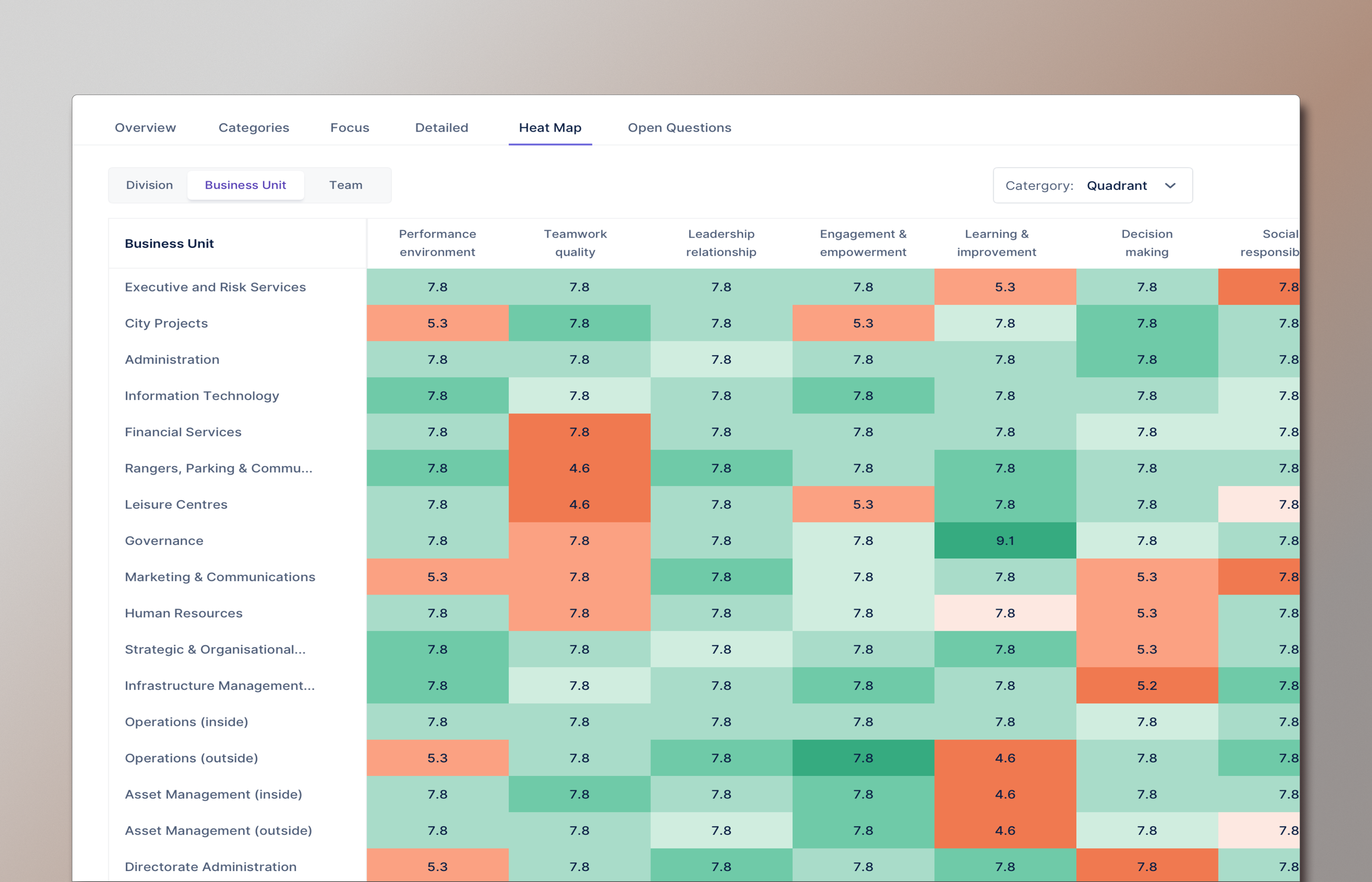
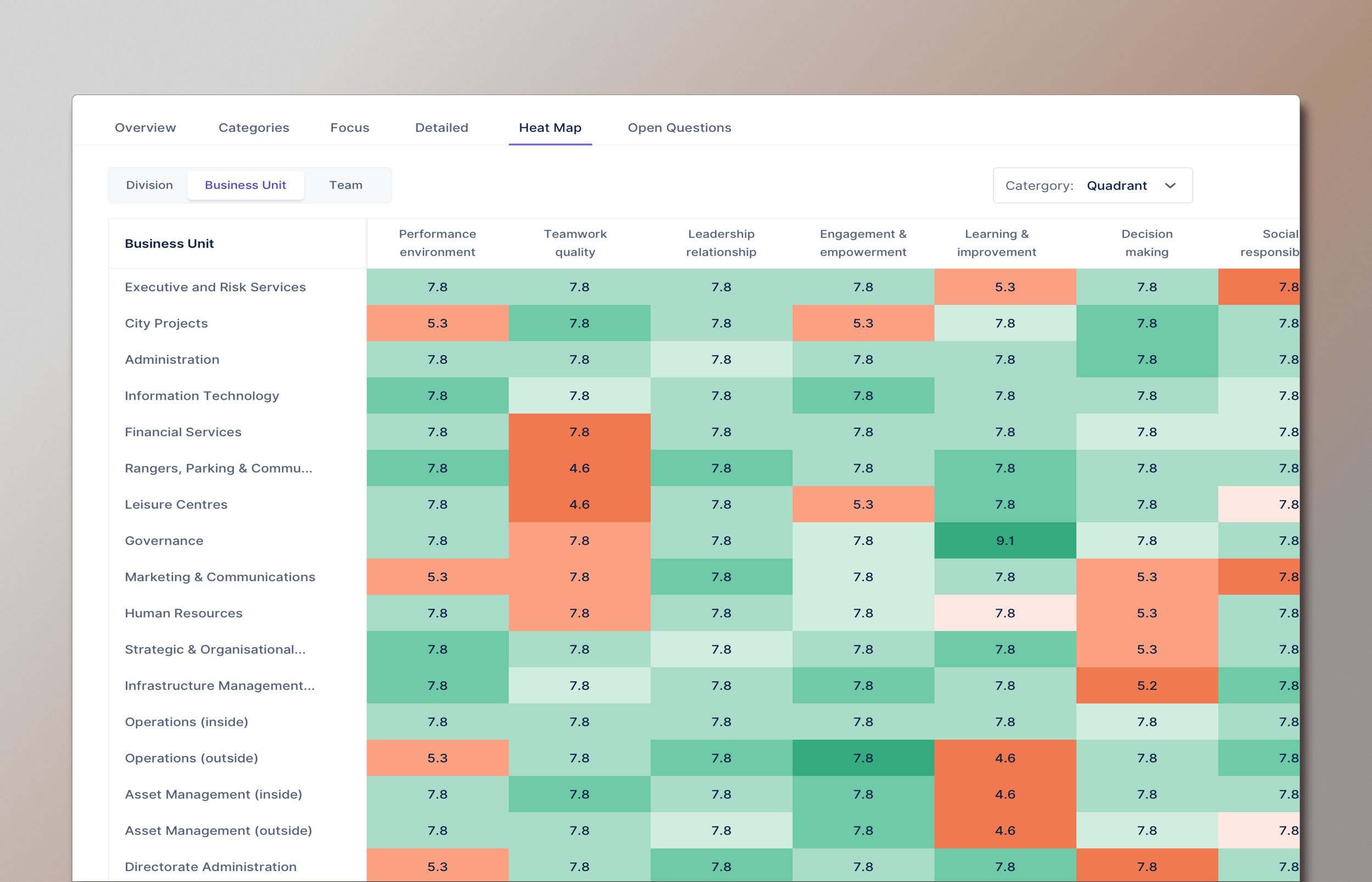
Hello Able’s organisation survey heat map
The Leadership Development Industry’s Dirty Little Secret.
Anybody working in the leadership development space knows measuring behaviour change, the actual development (or not) of leadership & management capabilities and organisation outcomes is the gold standard, rather than just measuring participant satisfaction and net promoter scores. But a dirty little secret of the industry is that most leadership development practitioners, L&D providers, HR teams, coaches and organisations still don’t measure behaviour change and capability development, let alone organisational outcomes such as improved retention or sales.
While many organisations value behaviour change and approximately 78 % say it’s the most important measure, the actual implementation of robust behaviour-change measurement is far lower - under 40%.
Measuring the impact of leadership development initiatives has always been a challenge. Many L&D practitioners and companies rely on superficial metrics, such as attendance and participant satisfaction (“happy sheets”), which fall short of capturing how a program truly shapes behavior and drives meaningful outcomes. Evaluating and analysing program quality, impact and outcomes is challenging for several reasons and an area that few practitioners and organisations are able to put the resources into doing thoroughly.
At Hello Able we're making it super easy for everyone to measure and benchmark behaviour change.
Challenges of Measuring Behaviour Change & Leadership Capability Development.
There are many reasons why organisations and practitioners find it challenging to measure behaviour change in leadership development initiatives, a few key challenges are:
Lack of clear alignment to business outcomes: many programs are designed with learning in mind, but not tightly connected to specific behavioural indicators or business-metrics. As noted by Harvard Business Publishing, a common pain point is: “The business is asking for proof, I don’t know where to start.”
Difficulty in capturing the right data at the right time: behaviour change often happens after the formal program, in day-to-day work, and is diffuse. Capturing meaningful data is therefore challenging.
Measurement capability and design issues: L&D teams often have limited experience in designing robust measurement frameworks that go beyond simple metrics. Many L&D professionals feel unequipped with analytics skills or the frameworks needed.
Complex, Multi-Level Impact & Confounding Variables: leadership development programs typically generate multi-level changes: individual behavioral change, and changes in team dynamics and organisational culture.
Attribution and confounding variables: even if you observe behaviour change or improved outcomes, isolating which intervention caused it is hard. Many other variables (organisational change, culture, team dynamics, external market conditions) intervene.
Time-lag and sustainability of behaviour change: behaviour change often requires time, reinforcement, follow-up, and embedding in job practice. Measuring too early or only one snapshot may miss the real impact. Many programs measure immediately post-training (reaction, learning) but rarely track six-, nine-, twelve-months later to see whether new behaviours are sustained or embedded in daily work.
Our Approach to Measuring Behaviour Change.
At Hello Able we’re committed to helping leadership development practitioners measure the impact of programs on participant behaviour, leadership capability development and organisational outcomes. We designed Able to make it easy for practitioners to deploy a comprehensive, customisable, evaluation methodology on all programs.
Pre-designed Evaluation Process: Able comes with a pre-designed set of program evaluation surveys, tools and leadership profiles so practitioners can be up and running with best practices tools in a few minutes. Able makes it easy to include pre- and post-program measures to demonstrate impact has improved the leadership & management skills of participants, based both on participant self-assessment and feedback from others (eg. managers and/or peers).
Best-Practice Methodology: our evaluation methodology and platform is based on best-practice research to ensure it captures information on the most impactful aspects of a program, and is aligned with Kirkpatrick's learning evaluation model.
Norms & Benchmarking: Able’s 180º and 360º feedback leadership & management profiles have over 40,000 responses so you can easily benchmark individual and group leadership & management capabilities.
Automated Process & Scheduling: Able’s evaluation process and leadership profiles are semi-automated to ensure consistent and continuous measurement of program outcomes. Surveys can be set to automatically send pre-program, post-session or post-program, and 360º leadership profiles can be scheduled at the appropriate intervals eg. pre-program and 9-12 months post-program.
Multi-level Measures: our surveys and measures cover a range of levels: participant intent (intake forms), post-session participant evaluations (including quality, impact and Net Promoter Score measures), individual behavioral change (via 180º or 360º feedback leadership & management profiles), professional development plans, and organisation surveys (culture and outcomes).
Capture Data at the Right Time: Able’s monthly pulse surveys and 180º or 360º feedback leadership & management profiles help you measure behaviour change in the flow of work.
Built-in Reporting & AI Summarisation: built in real-time reporting captures program evaluation and behaviour change data in realtime so you can easily monitor impact. Reports capture all levels - individual participant, sessions, individual practitioner, program cohort, project and organisation level data. AI summarises data into simple bite sized chunks for participants, project teams and clients to easily understand.
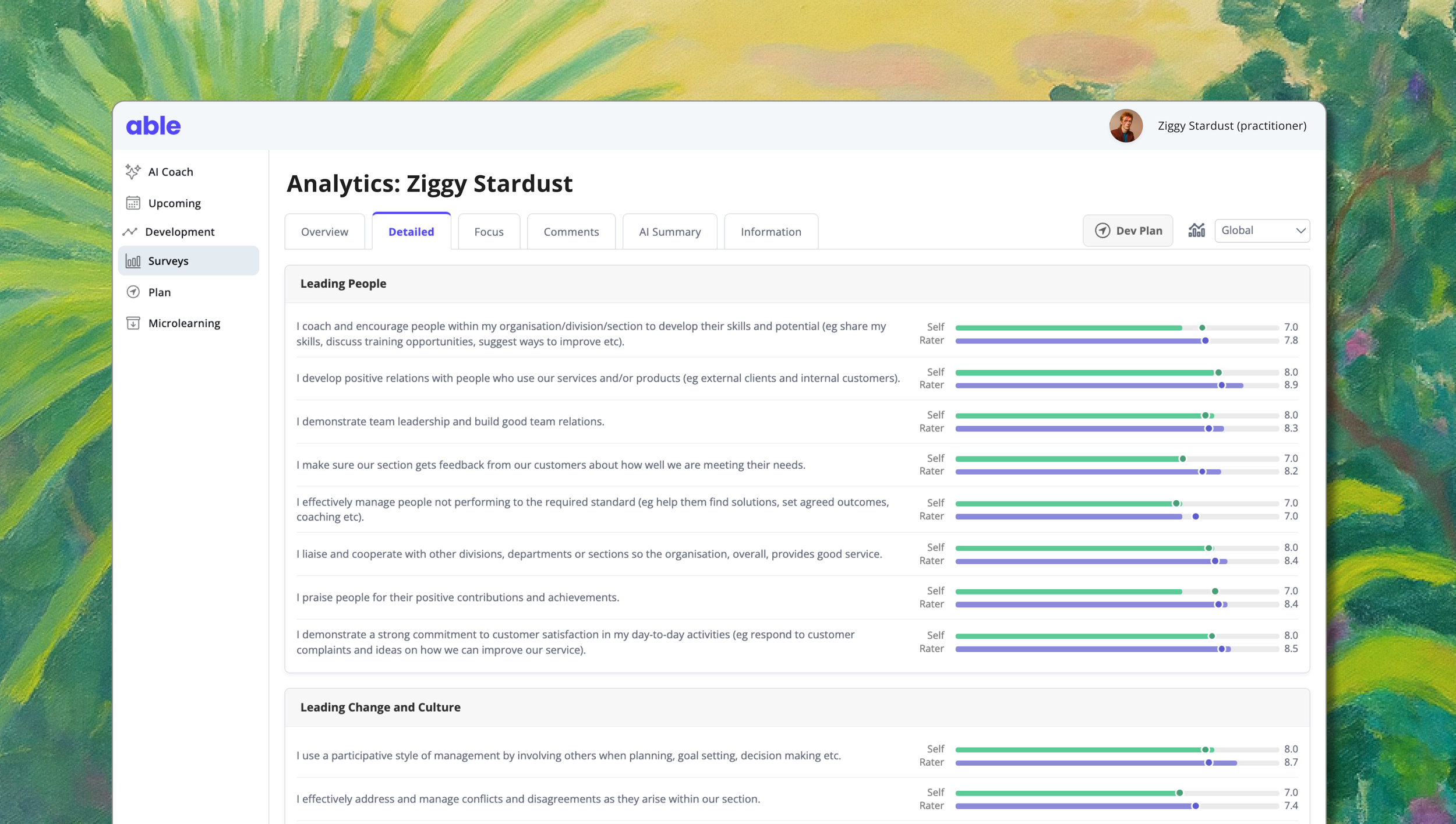
Hello Able’s leadership 360º feedback profile report
Best-Practice Program Evaluation Process to Measure Behaviour Change.
Depending on your clients specific needs we recommend using Hello Able to deliver the following program and participant evaluation process:
Pre-Program Participant Questionnaires (Intake Form): prior to the first session we recommend onboarding participants with a pre-program questionnaire to help assess participant needs, skills and priorities.
Pre-Program Leadership & Management Profiles (a 180º or 360º feedback process): include a pre-program feedback process to measure & benchmark participant capabilities and opportunities for development. Able’s Leadership & Management feedback profiles come in three flavours; participant only (self); self and their manager (180º); and self, managers, peers & direct-reports (360º). Pre-program 360º feedback can be done a month or 2 prior to the core program to assist in the design of the core program or in the early stages of the core program.
Post-Session Participant Evaluations: after each workshop or coaching session we recommend emailing participants/coachees a short survey to collect feedback about the session across a range of aspects - attendance, quality, engagement, learning/knowledge transfer, impact, facilitator/coach fit and environment. You can also get participants/coachees to complete these surveys at the end of the session. Able allows you to easily set these evals up with 1 or 2 clicks, and then review aggregated data as it comes in. Reviewing post-session evaluations allows you to continuously improve the program in an iterative way and stay in-front of any issues.
Pulse Surveys: a monthly survey/form for participants to complete to help track self-perceived behaviour change across five core capabilities from the Leadership & Management 360º Profile, reflect on the past months progress and set three goals for the next month.
Post-Program Participant Evaluations: Able lets you easily survey every participant at the end of the program. The post-program survey merges the last session eval to reduce survey fatigue. The post-program survey collects participant feedback on quality scores for programs components; program strengths & areas for improvement; and self-assessed impact.
Post-Program Leadership & Management Profiles: we recommend including a post-program feedback process to measure and benchmark participant capability development compared to your initial measure. To minimise survey fatigue you may consider just using a 180º feedback process (ie. self and manager). If you have purchased an annual Learner Plans for your participant you can redo Leadership Profiles as many times as you like through-out the year, so pricing shouldn’t be too much of an obstacle to re-measures.
Pre/Post-Program Reporting: Able’s Insights and program surveys come with pre/post-program reporting built in, so it is easy to evaluate program quality and impact, along with comparison to our norms. We recommend you incorporate a post-program debrief with your client to review and discuss program & participant data, insights, issues and any recommendations you may have for next steps.
Helloable.co is a Unified Intervention & Analytics Platform
Able is a unified intervention and analytics platform for leadership development practitioners, bringing together both the delivery and measurement of initiatives. Able streamlines program evaluations, leadership capability measures and organisation surveys so you can focus on driving real behaviour change - not admin.
Learn more about Hello Able’s analytics features →
Learn more about Hello Able’s leadership profiles →
Learn more about Hello Able’s organisation surveys →
References:
VeeMind: https://veemind.com/the-state-of-leadership-development-in-2024
HBR: https://www.harvardbusiness.org/wp-content/uploads/2023/06/Measuring-the-Impact-of-Leadership-Development-Slides.pdf
Ivey Business School: https://www.ivey.uwo.ca/executive-education/insights/2025/04/measuring-the-true-impact-of-leadership-development-a-holistic-approach/?utm_source=chatgpt.com
Most L&D Intitiatives Don't Stick: Custom designed AI Agents could help change that.
Despite spending $100B a year on leadership development, most L&D initiatives don't stick: Custom designed AI Agents could help change that.
As agents and language models improve the case of using AI agents to help implement large scale leadership development and behaviour change is becoming increasingly compelling.
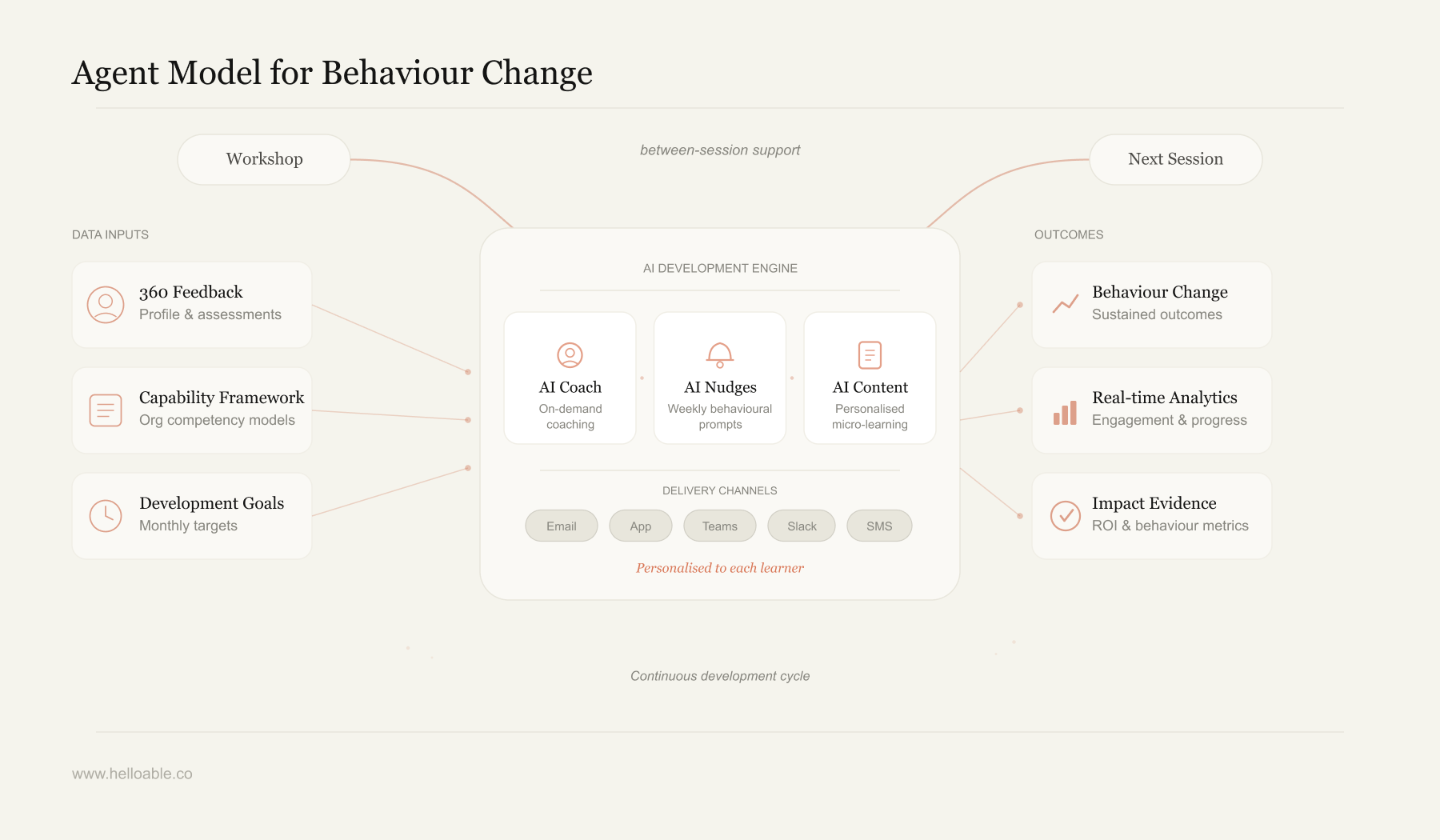
At Hello Able we’re building AI agents to deliver AI-driven coaching experiences, AI-driven nudges and other AI-driven interventions customised to the organisational context, that support in-person learning and development and allow enterprises to deliver large scale behaviour change across the entire organisation.
The $100 Billion Problem Nobody Wants to Talk About
Every L&D leader knows the feeling. You've just wrapped a leadership development program — two days of workshops, world-class facilitators, engaged participants. The feedback forms glow. Three months later, nothing has changed.
This isn't a failure of intent. It's a failure of design. The global leadership development market is worth approximately $100 billion a year and growing, yet most organisations still rely on event-based training — workshops, offsites, courses — that deliver a burst of insight with no mechanism for sustained follow-through. Participants return to their desks, inbox avalanches resume, and the carefully designed learning fades into memory.
If you're an L&D manager, HR director, or People & Culture leader at a mid-to-large enterprise, you've likely spent years trying to solve this. You've tried post-workshop surveys, action plans, buddy systems, manager check-ins. Some help. None scale. And none give you the data you need to prove to the executive team that the investment actually changed behaviour.
That's about to change — and the shift is already underway.
The Rise of AI Agents in Enterprise Learning
The conversation around AI in L&D has evolved rapidly. In 2024, it was about content generation — using AI to produce e-learning modules faster. In 2025, the focus shifted to AI coaching platforms. Now, in 2026, the frontier is something more powerful: custom AI agents designed for your specific development programs.
Gartner predicts that 40% of enterprise applications will integrate task-specific AI agents by the end of 2026 — up from less than 5% in 2025. Josh Bersin's research confirms that the enterprise learning tech market is transforming around AI at an unprecedented pace, with agentic AI reshaping how organisations think about workforce development.
But here's what matters for L&D leaders: the opportunity isn't in generic AI tools. It's in agents designed around your capability frameworks, your program content, and your people's development goals.
What Custom AI L&D Agents Actually Look Like
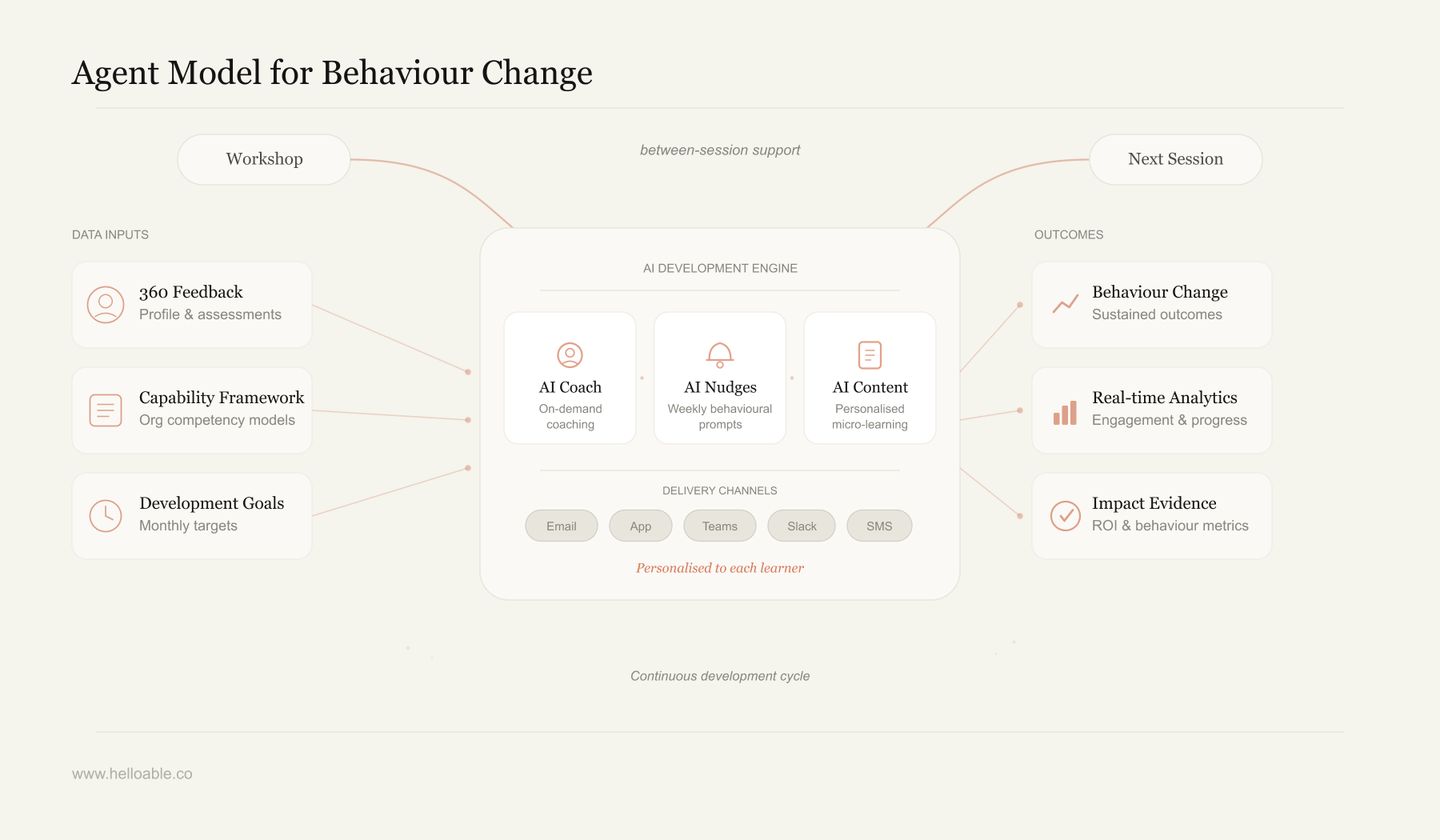
Forget the chatbot on your intranet. Custom AI agents for learning and development operate in three distinct modes, each addressing a different gap in the traditional learning cycle.
AI Coaches provide unlimited, on-demand coaching conversations aligned to each participant's development plan, 360-degree profile data, and program goals. Unlike generic coaching bots, these agents are trained on your organisation's capability framework and leadership model. A participant working on stakeholder influence doesn't get generic advice — they get coaching grounded in the specific competencies your organisation has defined, informed by their own feedback data.
AI Nudge Systems deliver short, targeted behavioural prompts between workshops and coaching sessions. Drawing on the Nobel Prize-winning behavioural science of Thaler and Sunstein's nudge theory, these systems send weekly micro-interventions — via email, app notification, or messaging platform — that are aligned to each learner's monthly development goals. The nudges are reply-able: participants can engage in a quick exchange, reflect on a challenge, or commit to a specific action. The evidence is compelling. McKinsey research shows AI-driven nudges boost productivity by 8–10% and cut rework by 20–30%. Perceptyx's AI Coach, grounded in a library of over 2,500 behavioural science nudges, has demonstrated manager feedback score improvements of eight to twelve points within six months. At Kraft Heinz, 85% of people managers engage actively with AI nudge systems.
AI Content Generators create personalised micro-learning content — articles, reflection prompts, scenario exercises — tailored to each learner's role, capability gaps, and program stage. Instead of a static resource library, participants receive content that evolves with them through the program.
The combined effect is what the research calls "between-session support" — and it significantly increases the likelihood of long-term behavioural change. These agents don't replace your facilitators or coaches. They extend the reach of every workshop, every coaching session, every development conversation into the days and weeks that follow.
Blended Learning, Reimagined
The most effective L&D programs in 2026 aren't choosing between human and AI. They're integrating both into a coherent system.
The emerging model looks like this: in-person workshops and coaching sessions provide the high-impact, relational experiences that build trust, shift mindsets, and create shared language. AI agents operate in the spaces between — reinforcing key concepts, prompting practice, providing feedback, and collecting data on engagement and progress.
This isn't about bolting AI onto an existing program. It's about designing programs from the ground up with continuous development in mind. The workshop becomes the catalyst. The AI agents become the sustaining force. The capability framework becomes the connective tissue that ensures every interaction — human or AI — is aligned to the same outcomes.
iVentiv's 2026 L&D trends research confirms this shift: digital learning is evolving beyond standalone formats into richer, blended ecosystems that combine immersive technologies, scenario-based simulations, and in-the-flow-of-work tools. The future of L&D, as Intellum puts it, isn't courses — it's continuous, contextual development embedded directly into the flow of work.
For L&D leaders managing multiple cohorts, providers, and programs, this means a fundamental rethink. You need a system that connects program design to delivery to measurement — and integrates AI agents as a native part of that system, not as a standalone experiment.
The Personalisation Problem — Solved at Scale
One of the persistent challenges in enterprise L&D is personalisation. You know that a one-size-fits-all leadership program underserves everyone. A first-time manager and a senior director have different development needs, even within the same capability framework. But designing truly personalised pathways for hundreds or thousands of learners has been prohibitively expensive — until now.
Custom AI agents solve this by operating at the intersection of two data sources: the organisation's capability profile (what good looks like for each role) and the individual's development data (360 feedback, pulse check results, coaching notes, self-assessments). The agent uses both to calibrate every coaching conversation, every nudge, and every piece of content to the individual learner.
This is where custom design matters. An off-the-shelf AI coaching platform applies its own methodology. A custom agent embeds your methodology — your competency models, your language, your organisational values. Participants experience it as an extension of the program, not a generic tool.
The data that flows back is equally valuable. Instead of relying on end-of-program surveys to understand impact, you have real-time engagement data, behavioural indicators, and progress metrics across every learner and cohort. For the first time, you can answer the question every executive asks: did this program actually change how people lead?
Why Hello Able
Hello Able is the platform where enterprises and their L&D partners design, deploy, and measure these custom AI agents — integrated with the full lifecycle of blended development programs.
Able isn't an AI coaching startup. It's an operating system for learning and development that connects program design, delivery, measurement, and AI-powered development into a single platform. Custom AI coaches, nudge systems, and content generators are built into the same system that manages your 360 profiles, pulse surveys, workshop scheduling, facilitator coordination, and impact reporting.
This integration is what makes the approach work. The AI coach knows what the learner's 360 data says. The nudge system aligns to the goals set in the development plan. The impact dashboard shows how AI-driven engagement correlates with behaviour change scores. Nothing is siloed. Nothing requires stitching together with spreadsheets.
For L&D leaders who've spent years wrestling with fragmented tools — an LMS here, a survey platform there, coaching operations in a spreadsheet — Able provides the consolidated system they've been asking for. For organisations that want to extend the impact of practitioner-led programs with AI, Able is where you design and deploy those agents without building custom technology from scratch.
The Moment Is Now
Leadership training remains the number one L&D priority for 2026, with 61% of organisations citing it as their primary focus. The pressure to demonstrate measurable behaviour change — not just participation — is intensifying. And the technology to deliver sustained, personalised, AI-powered development at scale has matured from experimental to enterprise-ready.
The question for L&D leaders isn't whether AI agents will become part of your development programs. It's whether you'll design them around your organisation's unique needs, or settle for generic tools that don't speak your language.
If you're ready to explore what a custom AI L&D agent could look like for your organisation — integrated with your capability frameworks, your programs, and your practitioners — we'd welcome the conversation.
Learn more about AI-generated Coaching and Nudges →
Talk to us at about designing your custom L&D AI agents →
Sources & Research
Gartner (2025): Predicts 40% of enterprise applications will integrate task-specific AI agents by end of 2026, up from less than 5% in 2025. via HR Morning
Josh Bersin (Feb 2026): "The Enterprise Learning Tech Market Quickly Transforms Around AI." joshbersin.com
McKinsey: AI-driven nudges boost productivity 8–10% and cut rework 20–30%. mckinsey.com
Perceptyx (April 2025): Launched first "experience-aware" AI coaching agent with 2,500+ behavioural science nudges; manager feedback scores improved 8–12 points in six months. globenewswire.com
Kraft Heinz: 85% of people managers in top two engagement categories with AI nudges. infeedo.ai
iVentiv (2026): L&D trends — skills-based organisations, AI governance, and blended learning ecosystems. iventiv.com
Intellum (2026): 4 AI trends in L&D — continuous, contextual coaching in the flow of work. intellum.com
EF Corporate Learning (2026): Leadership training #1 priority for 61% of organisations. corporatelearning.ef.com
Global leadership development market: Valued at $81B in 2024, projected to reach $217B by 2034. Able Research / Future Market Insights
Practice.do Shuts down: here’s why Able is your next platform.
Practice.do just shutdown, leaving 1,000s of coaches without a home for their clients, programs and team. If you’ve been using Practice, you’ll already know how much of your business runs through one platform. Migrate to Able now and scale with confidence.

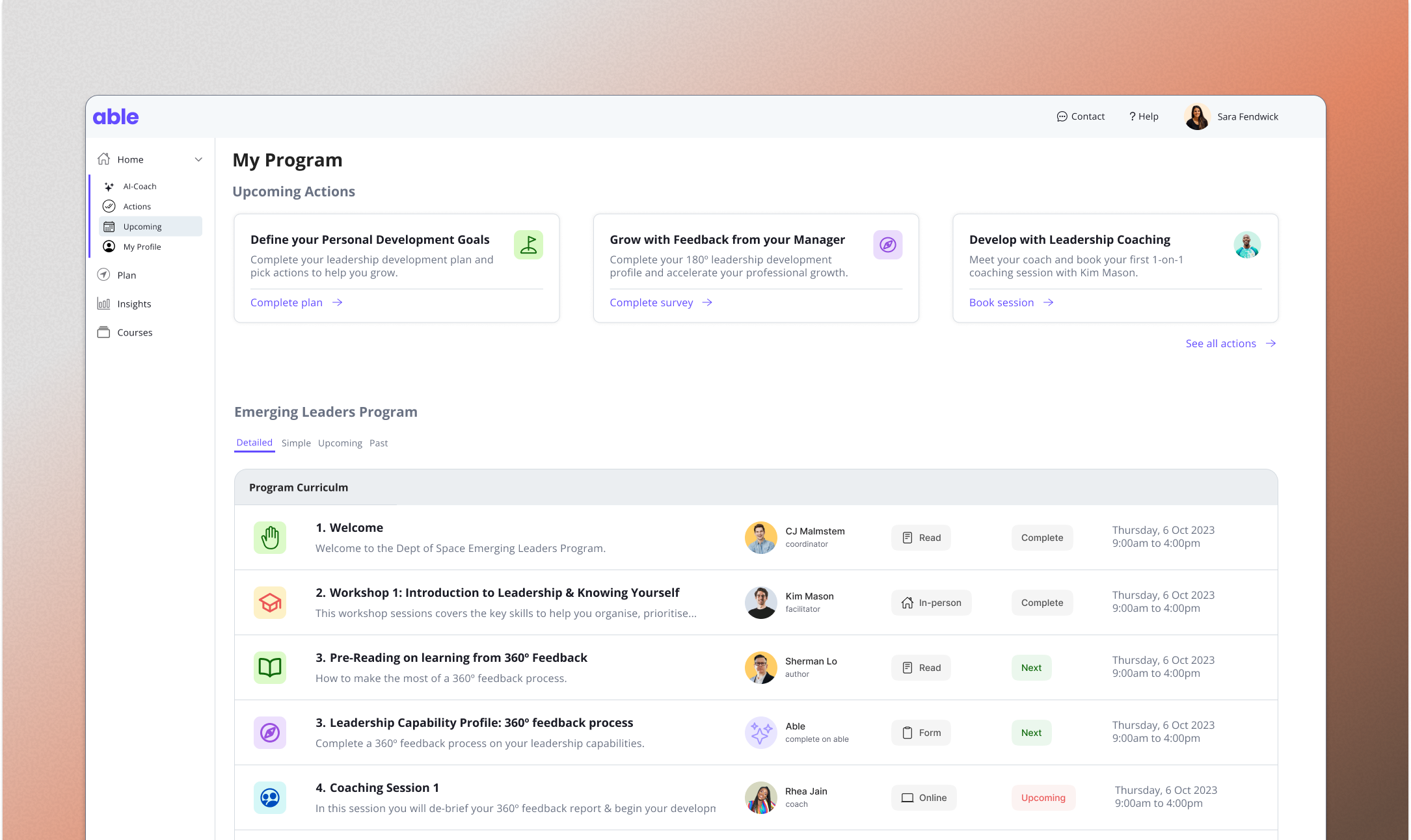
Able’s Leader portal for coaching clients.
Your coaching business deserves more than a temporary fix.
Migrate from Practice.do to Able now and scale with confidence.
If you’re a coach searching for a new home after Practice.do here’s why Able is your next platform. If you’ve been using Practice.do, you’ll already know how much of your business runs through one platform: scheduling, payments, clients, notes, the portal. When Practice suddenly announced it shutdown on 3 Nov 2025, it left many coaches scrambling to salvage their workflows, reassure clients, and rebuild.
We at Hello Able know how unsettling that is and we believe this moment is also a unique opportunity: a chance to not just find a replacement platform, but to upgrade to one that supports your growth, collaboration, measurement, and future business model.
Here’s why Able is designed for coaches like you and how you can migrate quickly, seamlessly, and start bigger and better.
We’re keen to help make the transition as smooth as possible, if you need help or have questions email me at anytime.
Oh and Able is free for coaches and L&D providers.
Jonah Cacioppe
CEO at Hello Able
jonah@helloable.co
Why you need more than a “just replacement” platform
When you’re faced with a platform shutdown, you naturally look for “something that does the same”. But what if you build your business on a platform that offers more?
Here’s what many coaches are worrying about now:
“Will I lose my client portal, payment history, scheduling flows?”
“How much time will I spend rebuilding instead of coaching?”
“Will my clients feel the change and be distracted?”
“Can I scale beyond 1:1 coaching (group, team, corporate)?”
“Will I have analytics to show ROI, serve organisations, not just individuals?”
A replacement platform that offers only the same features means you’re still rebuilding. But if you choose a platform that delivers next-level features, you’re building forward.
How Able supports you — and takes you further
Here’s how Able addresses the pain points —and gives you extras you didn’t have before:
Full business workflow & project management: Able supports quotes, proposals, project sign-off, follow-ups, scheduling, session links (Zoom/Teams), calendar integrations. Able - Leadership Platform
Scale beyond solo coaching: If you work with clients, facilitators, teams, L&D functions, Able offers features built for providers and multi-practitioner practices. Learn more →
AI-powered coaching & nudges for learners: Push your offering beyond one-on-one by embedding AI-coach, micro-learning, nudges, leadership profiles. Your clients get richer value, you get recurring revenue. Learn More →
Measurement, analytics & behaviour change: Many platforms stop at scheduling. Able gives you dashboards, evaluations, 180º/360º feedback, programme ROI – which positions you to serve organisations that demand measurement. Able - Leadership Platform+1
Community & global practitioner network: You’re not alone. Join a network of coaches, facilitators, consultants. Share leads, co-deliver, expand your footprint. Able - Leadership Platform
Flexible pricing & free/entry tier: Able’s pricing structure allows you to test, transition, and then scale when you’re ready. Able - Leadership Platform
Migration made simple – so you don’t lose momentum
We understand that when your platform shuts down, time is critical. Here’s how you can move smoothly:
Export from Practice.do: Immediately extract your client list, appointments, forms, files, workflow automations. (Practice’s shutdown notice emphasises this urgency.) practice.do+1
Set up on Able: Create your account, connect calendars with Calendly, payment tools, upload client data.
Re-frame your value: Use this migration as a marketing moment for your coaching business: “We’ve upgraded our technology to deliver even more value for you.”
Communicate with clients: Notify your clients of the platform change, reassure them of the seamless experience, possibly highlight new features (e.g., AI-nudges, AI-generated coaching, micro-learning and 360º feedback surveys).
Take advantage of this transition to scale: While you’re “resetting,” consider adding a subscription product, or embedding digital components to your coaching offering.
At Hello Able, our team is ready to support you during the onboarding phase, so you can get back to coaching quickly.
Five questions to ask when selecting your next coaching platform
Use this checklist to evaluate your new platform (and see why Able scores high):
Does the platform support your growth (from solo 1:1 to teams/cohorts)?
Does it provide automation and workflow (scheduling, sessions, payments, nudges) so you spend less time on admin?
Does it enable measurement and analytics (so you can serve corporate clients and show impact)?
Does it include advanced features (e.g., AI-coaching, micro-learning, learner journeys) that open new revenue streams?
Does the provider offer migration support, reliability & longevity (you don’t want to be in this “platform shut-down” position again)?
If the answer is yes to most of these, you’re on the right track.
Don’t just replace – upgrade your coaching business now
The shutdown of Practice.do may feel like a disruption, but it is also an inflection point. It’s your chance to move to a platform that doesn’t just manage your coaching business — it enables you to scale, diversify and measure your impact.
At Hello Able, we’re in the business of helping coaches and learning-providers thrive — by giving you the technology, network and intelligence you need.
Ready to make the move?
Create a free account now →
Book a demo →
Email me if you have any questions → jonah@helloable.co
Let’s build your future coaching business together.
Jonah Cacioppe
CEO at Hello Able
jonah@helloable.co